Optimizing Retention: The Rewards Rule Engine
Boosting Adoption 10x by Turning a Complex Rule Engine into an Intuitive Workflow. Scaling loyalty through automated logic and user-centricity.
The Strategic Vision
There’s always room to turn a cost center into a value driver
Rewards Rule is the backbone of our loyalty ecosystem, designed to automate complex incentive structures. While the existing system was functional, it was a "black box" for internal stakeholders and a point of friction for users. I led the end-to-end redesign to transform this backend-heavy tool into a high-performance engine that drives user retention and reduces operational overhead.
Why the Redesign?
Operational Bottlenecks: The previous rule-setting process was manual and prone to error, requiring developer intervention for simple campaign changes.
Low Transparency: Stakeholders lacked visibility into how rewards were triggered, leading to a "trust gap" in the system's accuracy.
Lack of Scalability: As the business scaled, the rigid architecture couldn't support the diversity of new reward types (points, cashback, partner vouchers) required by marketing1.
The Leadership Approach (Process)
I didn't just design screens; I architected a workflow.
Deep-Dive Research
I initiated a cross-functional audit involving Marketing, Product, and Data Engineering. We interviewed 10+ internal power users to map the "logic-building" journey.
The Discovery: We found that 60% of "rule failures" weren't technical bugs—they were logic conflicts created by a confusing UI.
Quantitative Validation
We analyzed 12 months of campaign data to identify the most frequent rule combinations. This allowed us to prioritize a "Modular Rule Builder" that addressed 80% of use cases with zero custom coding.
The Problem
We built a powerful rule engine for casinos to manage promotions, but adoption was almost zero. Marketing staff couldn’t use it without SQL skills, so they relied on Customer Success to create or update rules.
Data showed:
•. Less than 2% of users ever touched the tool.
• Most avoided it or quit halfway due to frustration and errors.
˘This caused serious issues:
• Slow campaigns – teams couldn’t move fast without technical help.
• Lost agility – casinos struggled to respond quickly to market changes.
• Costly mistakes – outdated or wrong rules led to complaints, refunds, and penalties.
In short: the tool was built for power, not usability. Non-technical users lacked confidence, avoided it, and turned it into a bottleneck instead of a self-service solution.
The Problem
We built a powerful rule engine for casinos to manage promotions, but adoption was almost zero. Marketing staff couldn’t use it without SQL skills, so they relied on Customer Success to create or update rules.
Data showed:
•. Less than 2% of users ever touched the tool.
• Most avoided it or quit halfway due to frustration and errors.
˘This caused serious issues:
• Slow campaigns – teams couldn’t move fast without technical help.
• Lost agility – casinos struggled to respond quickly to market changes.
• Costly mistakes – outdated or wrong rules led to complaints, refunds, and penalties.
In short: the tool was built for power, not usability. Non-technical users lacked confidence, avoided it, and turned it into a bottleneck instead of a self-service solution.
The Problem
We built a powerful rule engine for casinos to manage promotions, but adoption was almost zero. Marketing staff couldn’t use it without SQL skills, so they relied on Customer Success to create or update rules.
Data showed:
•. Less than 2% of users ever touched the tool.
• Most avoided it or quit halfway due to frustration and errors.
˘This caused serious issues:
• Slow campaigns – teams couldn’t move fast without technical help.
• Lost agility – casinos struggled to respond quickly to market changes.
• Costly mistakes – outdated or wrong rules led to complaints, refunds, and penalties.
In short: the tool was built for power, not usability. Non-technical users lacked confidence, avoided it, and turned it into a bottleneck instead of a self-service solution.
What actually user need
What actually user need
What actually user need
No-Code Rule Builder: A user-friendly, simple interface that allows users to create and modify rules without writing mathematical calculations or SQL queries, making rule creation accessible to non-technical users.
Predefined Templates & Rule Suggestions: Provide ready-to-use rule templates and AI-powered suggestions to simplify rule setup, reducing errors and saving time.(Not included in first iteration)
Real-Time Preview & Validation: A built-in preview and validation feature that lets users test rules instantly before applying them, ensuring accuracy and reducing reliance on developers.
No-Code Rule Builder: A user-friendly, simple interface that allows users to create and modify rules without writing mathematical calculations or SQL queries, making rule creation accessible to non-technical users.
Predefined Templates & Rule Suggestions: Provide ready-to-use rule templates and AI-powered suggestions to simplify rule setup, reducing errors and saving time.(Not included in first iteration)
Real-Time Preview & Validation: A built-in preview and validation feature that lets users test rules instantly before applying them, ensuring accuracy and reducing reliance on developers.
UX Vision & Goals
UX Vision & Goals
UX Vision & Goals
Provide operators an easy, plain text rules creator to add, edit, view & review rules. The rules will have additional criteria, fast processing, & enhanced personalization to positively impact both user & guest experience, encourage use of Loyalty marketing features and provide additional opportunities for enhanced marketing.
Simplify Rule Creation: Simple rule creation interface where a non technical marketing person can create and validate a desired rules without any help from technical staff
Increase Adoption: A simple and intuitive user interface empowers users to create new rules anytime without depending on technical staff.
Ensure scalability and ease of use to adapt to organizational growth: so that we can empower users with tools that enhance productivity and simplify workflows
Provide operators an easy, plain text rules creator to add, edit, view & review rules. The rules will have additional criteria, fast processing, & enhanced personalization to positively impact both user & guest experience, encourage use of Loyalty marketing features and provide additional opportunities for enhanced marketing.
Simplify Rule Creation: Simple rule creation interface where a non technical marketing person can create and validate a desired rules without any help from technical staff
Increase Adoption: A simple and intuitive user interface empowers users to create new rules anytime without depending on technical staff.
Ensure scalability and ease of use to adapt to organizational growth: so that we can empower users with tools that enhance productivity and simplify workflows
After setting the UX goals we statred working towards acheiving our ultimate goal of making this Rule engine simple and intutive and increse the adoption among customers
After setting the UX goals we statred working towards acheiving our ultimate goal of making this Rule engine simple and intutive and increse the adoption among customers
After setting the UX goals we statred working towards acheiving our ultimate goal of making this Rule engine simple and intutive and increse the adoption among customers
We started with understanding the existing app and flow
We started with understanding the existing app and flow
We started with understanding the existing app and flow
After engaging with the customer success team, I discovered
Current system for building rules and rewards lacked both structure and an intuitive interface.
Marketing teams at the casino felt uncertain about using the app because it was unclear what rules and rewards they were actually configuring.
This lack of clarity, combined with a non-intuitive design, led to a fear of making costly mistakes. As a result, most users depended heavily on the ATI team to set up rules and rewards for them, rather than doing it themselves.
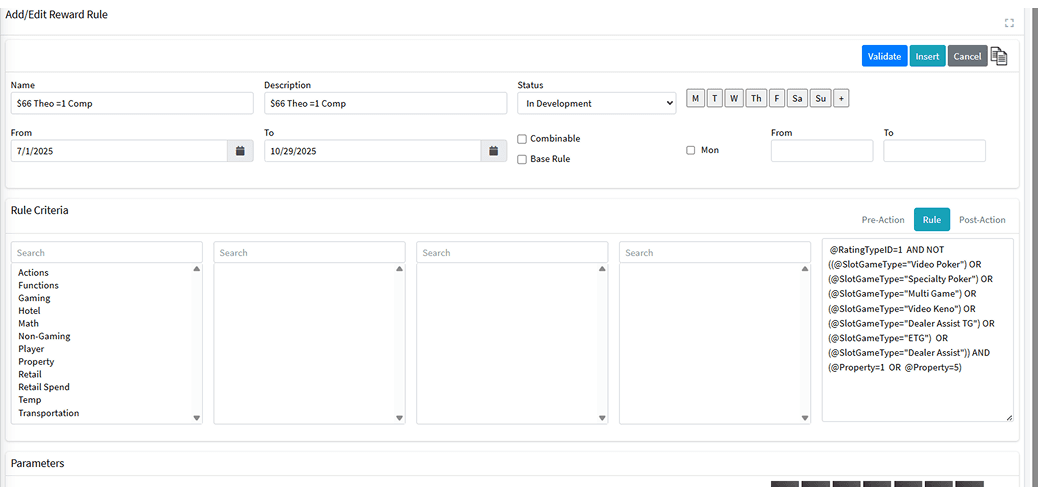
The previous app’s workflow, as shown in the screenshots, highlights these usability challenges.
UI interface is not intuitive
Not using user friendly labels
in Pre action and Post action user is expected to write formulas or SQL queries
User doesn’t know what reward and rules are building and how they will perform.
calculative symbols are not very user friendly to user and hard to use
After engaging with the customer success team, I discovered
Current system for building rules and rewards lacked both structure and an intuitive interface.
Marketing teams at the casino felt uncertain about using the app because it was unclear what rules and rewards they were actually configuring.
This lack of clarity, combined with a non-intuitive design, led to a fear of making costly mistakes. As a result, most users depended heavily on the ATI team to set up rules and rewards for them, rather than doing it themselves.
The previous app’s workflow, as shown in the screenshots, highlights these usability challenges.
UI interface is not intuitive
Not using user friendly labels
in Pre action and Post action user is expected to write formulas or SQL queries
User doesn’t know what reward and rules are building and how they will perform.
calculative symbols are not very user friendly to user and hard to use
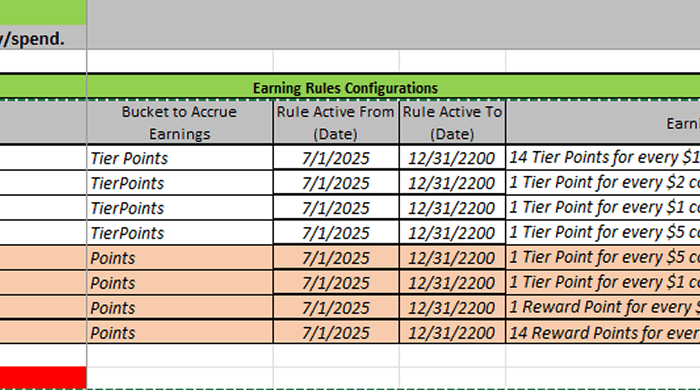
Sample existing rules
Sample existing rules
Sample existing rules
@CompDollars = ((((@CoinIN)*(@CalcTheoPct/100))/66.000)*0.790)*0.250; EXECUTE AddPlayerCompDollars
@CompDollars = ((((@CoinIN)*(@CalcTheoPct/100))/66.000)*0.790)*0.250; EXECUTE AddPlayerCompDollars
What Customer Success Team is doing
What Customer Success Team is doing
What Customer Success Team is doing
CS team was heavily busy in connecting with marketing team of casino over a zoom call, getting all requirements and then creating custom formula or SQL queries to build the Rule & Rewards as expected. This was time consuming and risky task as any wrong calculation may cost penalty to ATI
CS team was heavily busy in connecting with marketing team of casino over a zoom call, getting all requirements and then creating custom formula or SQL queries to build the Rule & Rewards as expected. This was time consuming and risky task as any wrong calculation may cost penalty to ATI
6 insights I got from our Research and User Interviews
6 insights I got from our Research and User Interviews
6 insights I got from our Research and User Interviews
Un-structured Process
Un-structured Process
Without a clear, structured way to build rules and rewards, users are left uncertain about how to proceed, leading to inconsistent and error-prone outcomes.
Without a clear, structured way to build rules and rewards, users are left uncertain about how to proceed, leading to inconsistent and error-prone outcomes.
Fear of Errors
Fear of Errors
When users cannot clearly see or understand the rules and rewards they are configuring, they fear making costly mistakes—especially in high-stakes environments like casinos.
When users cannot clearly see or understand the rules and rewards they are configuring, they fear making costly mistakes—especially in high-stakes environments like casinos.
User Feedback Needed
User Feedback Needed
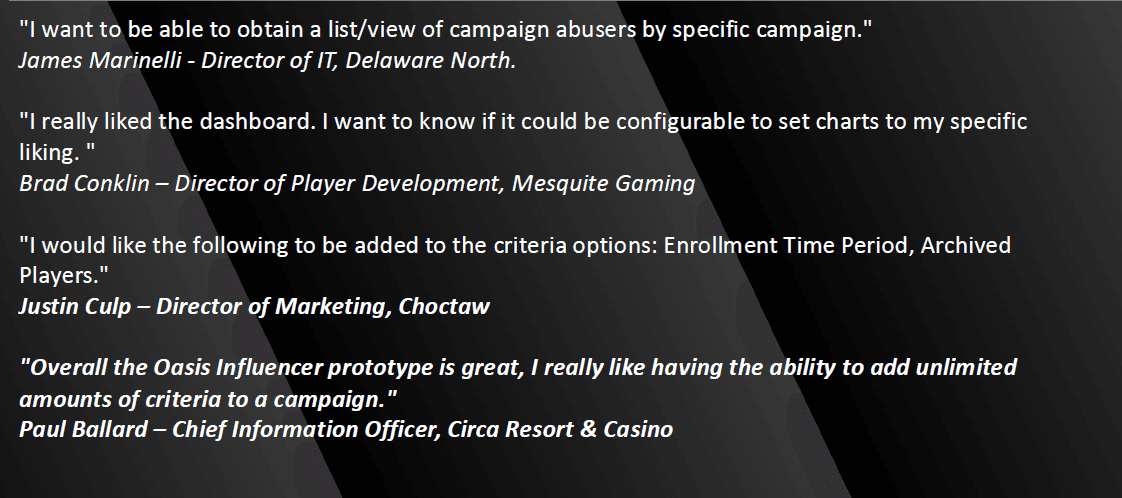
Engaging with end users (e.g., marketing teams) reveals their true needs and pain points, which may not be evident from system data alone.
Engaging with end users (e.g., marketing teams) reveals their true needs and pain points, which may not be evident from system data alone.
Unintuitive Interface
Unintuitive Interface
An unintuitive interface creates barriers for non-technical users, making them hesitant or even fearful to use the application for its intended purpose
An unintuitive interface creates barriers for non-technical users, making them hesitant or even fearful to use the application for its intended purpose
Dependency on IT
Dependency on IT
Due to usability issues, marketing teams are forced to depend on technical (ATI) teams for tasks that should be within their own scope, leading to inefficiency and bottlenecks.
Due to usability issues, marketing teams are forced to depend on technical (ATI) teams for tasks that should be within their own scope, leading to inefficiency and bottlenecks.
Preview Builds Confidence
Preview Builds Confidence
Providing real-time previews and step-by-step guidance empowers users, making them more comfortable and confident in using the system independently.
Providing real-time previews and step-by-step guidance empowers users, making them more comfortable and confident in using the system independently.
Key Decisions & Rationale
1. Introduced a No-Code Rule Builder
Replaced SQL dependency with a guided, no-code interface.
Impact: Enabled self-service rule creation, boosted adoption, and cut campaign turnaround time
2. Simplified, Step-by-Step Workflow
Restructured rule setup into a clear four-stage process with labels, help, and validations.
Impact: Reduced errors, improved task success, and sped up first-time completion.
3. Real-Time Preview & Rule Validation
Added instant feedback on rule behavior before deployment.
Impact: Increased accuracy, minimized misconfigurations, and reduced reliance on QA/support.
Key Decisions & Rationale
1. Introduced a No-Code Rule Builder
Replaced SQL dependency with a guided, no-code interface.
Impact: Enabled self-service rule creation, boosted adoption, and cut campaign turnaround time
2. Simplified, Step-by-Step Workflow
Restructured rule setup into a clear four-stage process with labels, help, and validations.
Impact: Reduced errors, improved task success, and sped up first-time completion.
3. Real-Time Preview & Rule Validation
Added instant feedback on rule behavior before deployment.
Impact: Increased accuracy, minimized misconfigurations, and reduced reliance on QA/support.
Key Decisions & Rationale
1. Introduced a No-Code Rule Builder
Replaced SQL dependency with a guided, no-code interface.
Impact: Enabled self-service rule creation, boosted adoption, and cut campaign turnaround time
2. Simplified, Step-by-Step Workflow
Restructured rule setup into a clear four-stage process with labels, help, and validations.
Impact: Reduced errors, improved task success, and sped up first-time completion.
3. Real-Time Preview & Rule Validation
Added instant feedback on rule behavior before deployment.
Impact: Increased accuracy, minimized misconfigurations, and reduced reliance on QA/support.
4. Plain Language Rule Representation
Displayed rules in plain English instead of technical syntax.
Impact: Improved clarity, faster reviews, and stronger cross-team communication.
5. Designing for Scalability and Flexibility
Built support for advanced rules and future AI-driven suggestions.
Impact: Created a future-ready system with minimal redesign overhead.
6. User-Centric Design Grounded in Research
Grounded design in stakeholder interviews to shape language, hierarchy, and workflows.
Impact: Increased user satisfaction, trust, and alignment with business goals.
4. Plain Language Rule Representation
Displayed rules in plain English instead of technical syntax.
Impact: Improved clarity, faster reviews, and stronger cross-team communication.
5. Designing for Scalability and Flexibility
Built support for advanced rules and future AI-driven suggestions.
Impact: Created a future-ready system with minimal redesign overhead.
6. User-Centric Design Grounded in Research
Grounded design in stakeholder interviews to shape language, hierarchy, and workflows.
Impact: Increased user satisfaction, trust, and alignment with business goals.
4. Plain Language Rule Representation
Displayed rules in plain English instead of technical syntax.
Impact: Improved clarity, faster reviews, and stronger cross-team communication.
5. Designing for Scalability and Flexibility
Built support for advanced rules and future AI-driven suggestions.
Impact: Created a future-ready system with minimal redesign overhead.
6. User-Centric Design Grounded in Research
Grounded design in stakeholder interviews to shape language, hierarchy, and workflows.
Impact: Increased user satisfaction, trust, and alignment with business goals.
New Rules & Reward- In devlopment
New Rules & Reward- In devlopment
New Rules & Reward- In devlopment

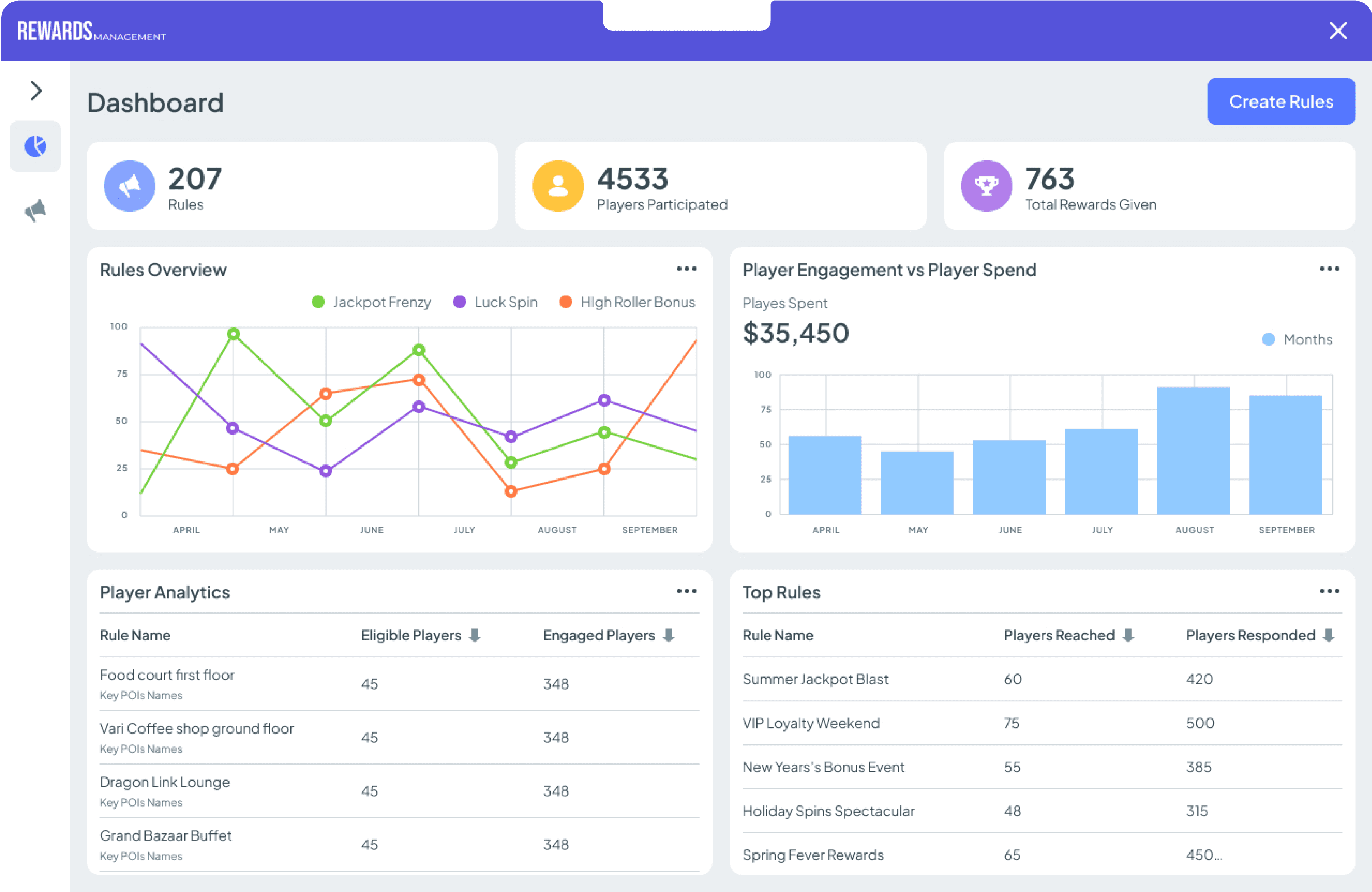
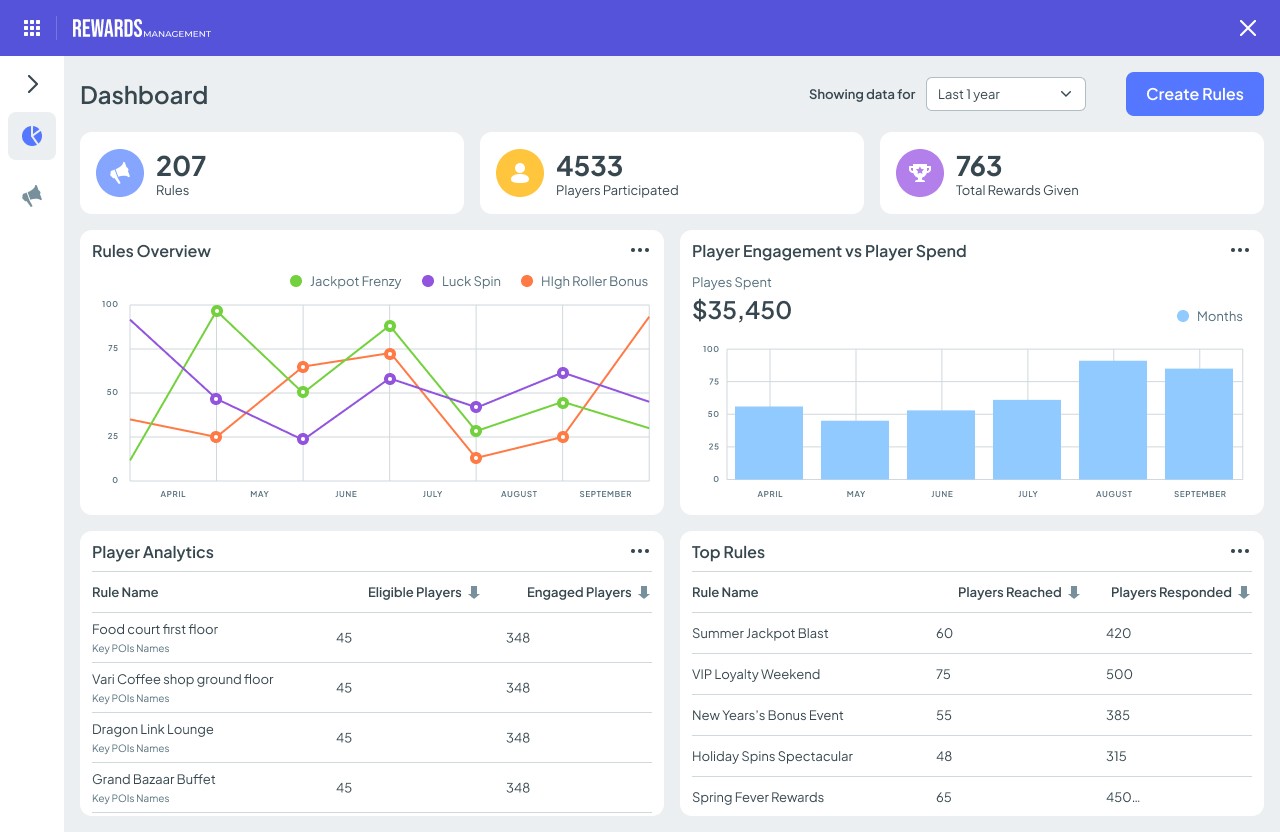
With this new solution, users can effortlessly create various rules and attach rewards using a simple, user-friendly interface for a seamless experience. The UI also offers high-level analytics on rule performance, enabling the marketing team to evaluate effectiveness and optimize future promotions efficiently.
Here’s our new feature on desktop
Here’s our new feature on desktop
Here’s our new feature on desktop
Dividing the process into five clear stages to ensures
Users aren’t overwhelmed,
Guiding them step by step for better clarity and focus.
This structure makes complex tasks intuitive, builds user confidence, and drives engagement by making the experience simple and manageable
Stepper at top to inform user at which stage they are in process
From first screen user knows they can preview at the end and trust the process
Dividing the process into five clear stages to ensures
Users aren’t overwhelmed,
Guiding them step by step for better clarity and focus.
This structure makes complex tasks intuitive, builds user confidence, and drives engagement by making the experience simple and manageable
Stepper at top to inform user at which stage they are in process
From first screen user knows they can preview at the end and trust the process
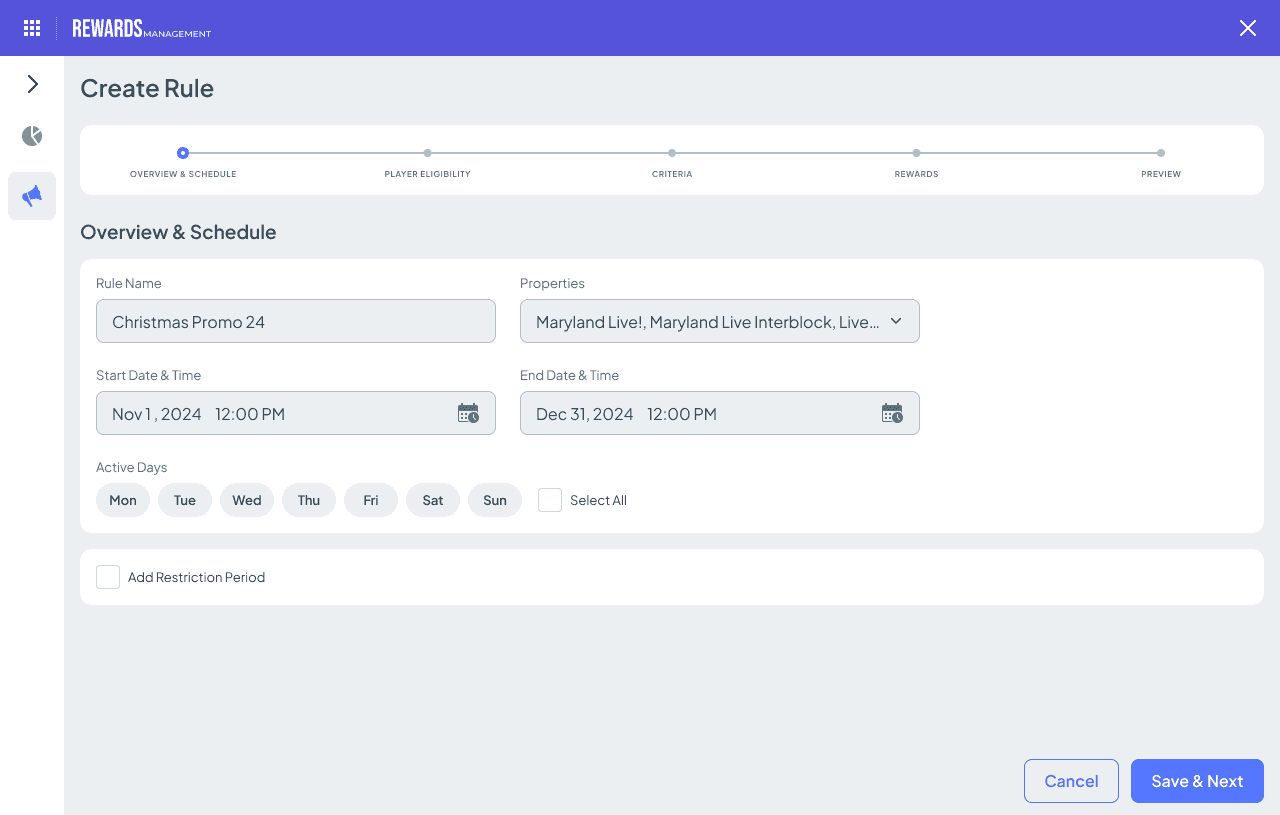
Step 1 - Create Rule Overview
Step 1 - Create Rule Overview
Users start by setting up the campaign overview and scheduling.
Establishes context and timeline upfront, so users understand the scope and aren’t overwhelmed by details too early
Users start by setting up the campaign overview and scheduling.
Establishes context and timeline upfront, so users understand the scope and aren’t overwhelmed by details too early
Step 2 - Set Player Eligibility
Step 2 - Set Player Eligibility
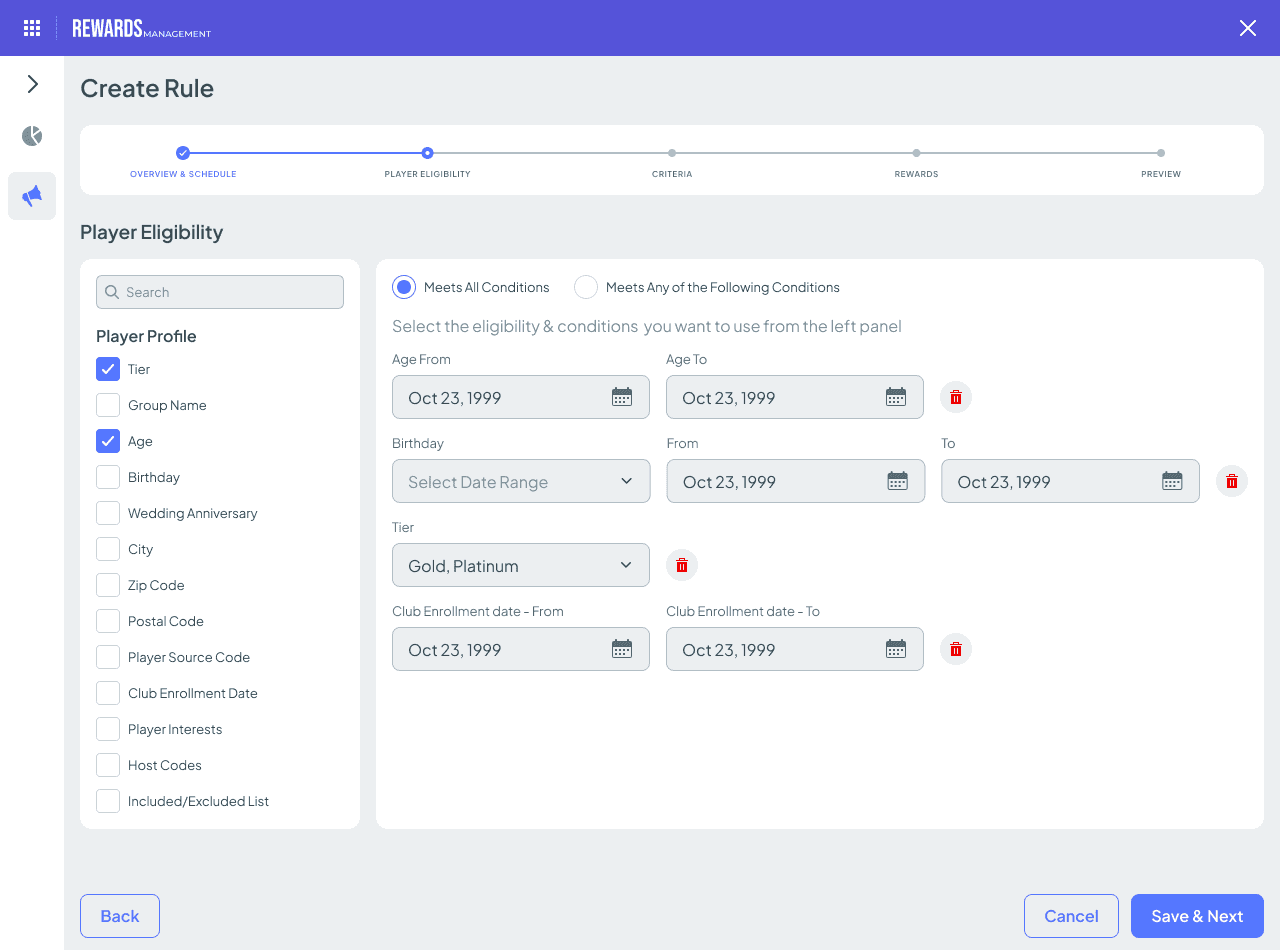
Define which players qualify for the campaign.
Breaks down the process, letting users focus on one decision at a time, reducing cognitive load and potential confusion
Define which players qualify for the campaign.
Breaks down the process, letting users focus on one decision at a time, reducing cognitive load and potential confusion
Step 3 - Set Criteria
Step 3 - Set Criteria
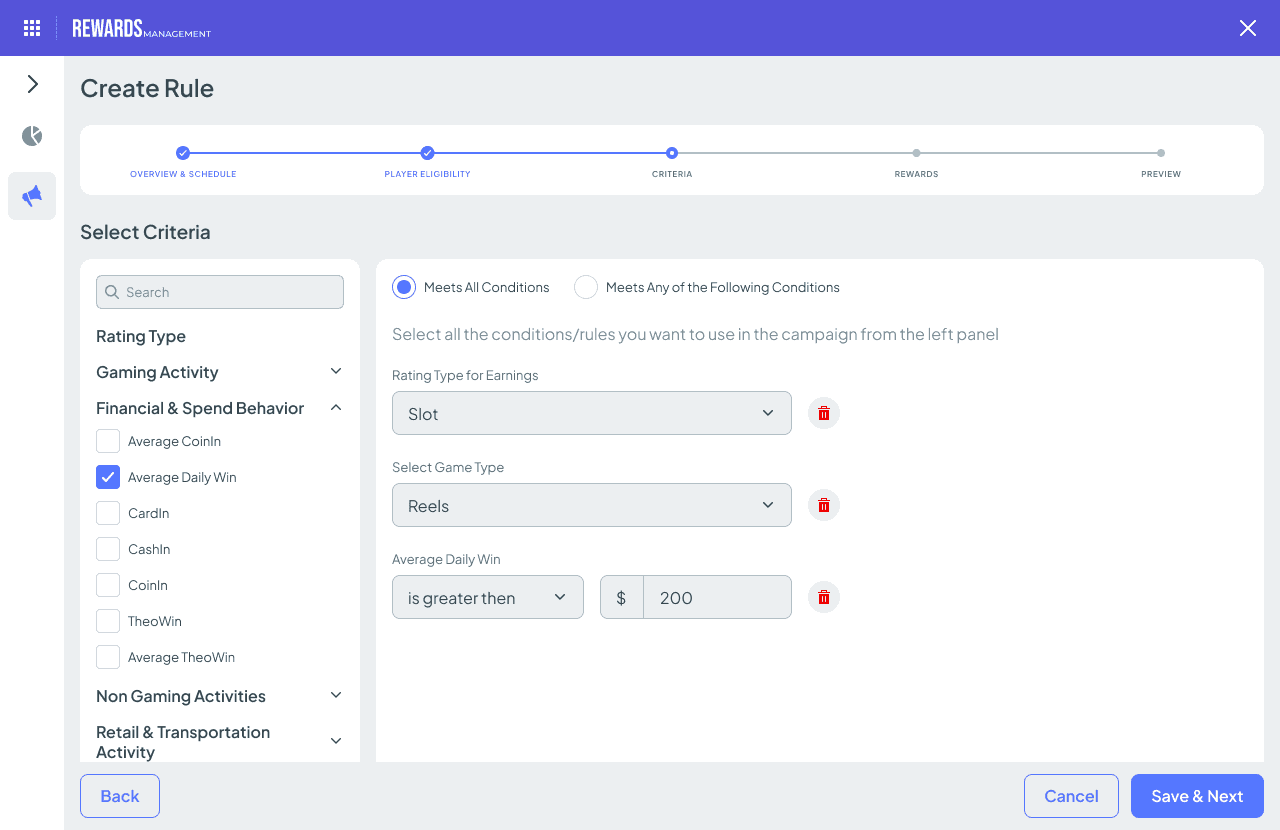
Set the specific conditions or triggers for rewards.
Isolates rule-building into a clear, manageable step, making complex logic more approachable and intuitive
Set the specific conditions or triggers for rewards.
Isolates rule-building into a clear, manageable step, making complex logic more approachable and intuitive
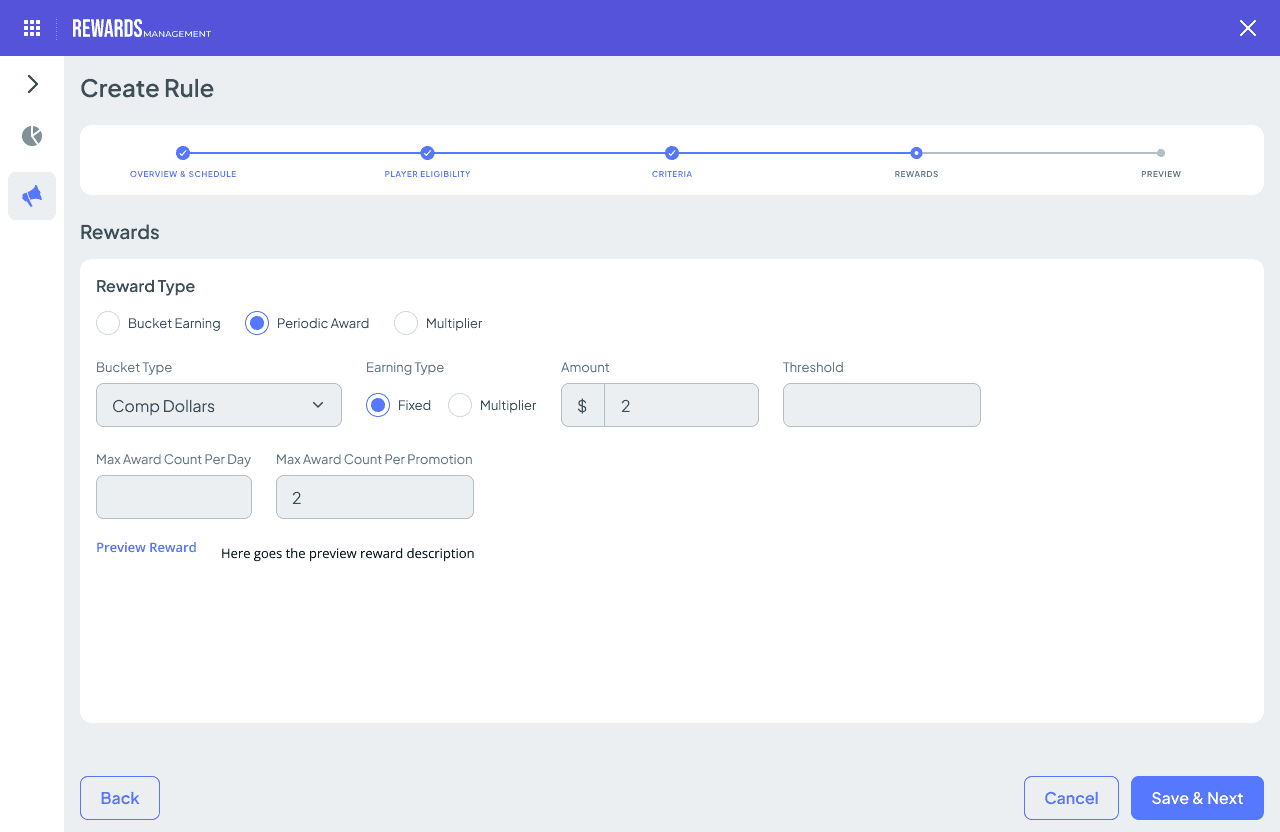
Step 4 - Setting Rewards
Step 4 - Setting Rewards
Configure and preview the rewards players will receive.
Keeps reward setup separate, allows real-time feedback, and ensures users can clearly see the outcome before finalizing, boosting confidence and minimizing errors
Configure and preview the rewards players will receive.
Keeps reward setup separate, allows real-time feedback, and ensures users can clearly see the outcome before finalizing, boosting confidence and minimizing errors
Step 5 - Preview
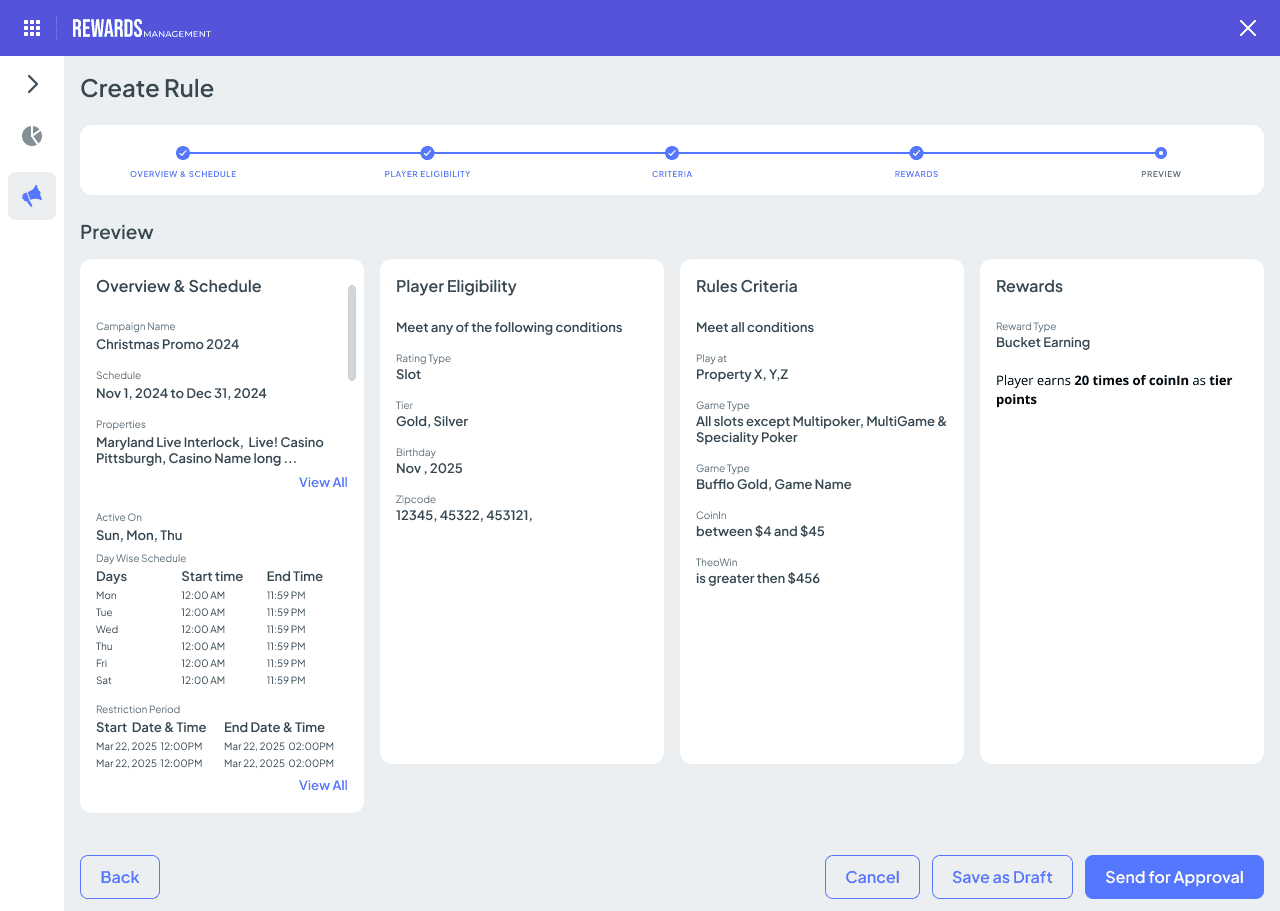
Step 5 - Preview
Review a summary of all selections before finalizing.
Providing a preview stage gives users confidence, reduces errors, and ensures they understand the outcome before committing—making the process more intuitive and less intimidating
Review a summary of all selections before finalizing.
Providing a preview stage gives users confidence, reduces errors, and ensures they understand the outcome before committing—making the process more intuitive and less intimidating
The Outcome
The Outcome
By restructuring the rule and reward creation process into four intuitive stages, we transformed a confusing, technical workflow into a user-friendly experience. This approach empowered marketing teams to work independently, reduced errors, and increased overall engagement. The project highlights the value of user-centered design in solving real business challenges and demonstrates how thoughtful UX can drive both adoption and efficiency.
By restructuring the rule and reward creation process into four intuitive stages, we transformed a confusing, technical workflow into a user-friendly experience. This approach empowered marketing teams to work independently, reduced errors, and increased overall engagement. The project highlights the value of user-centered design in solving real business challenges and demonstrates how thoughtful UX can drive both adoption and efficiency.
Key Takeaways
Key Takeaways
A well-structured, intuitive interface not only improves usability but also builds user confidence—turning hesitant users into empowered advocates
—Feeling them empowered they create / edit the rewards without ATI dependencies
—Everybody the new solution
A well-structured, intuitive interface not only improves usability but also builds user confidence—turning hesitant users into empowered advocates
—Feeling them empowered they create / edit the rewards without ATI dependencies
—Everybody the new solution
Next Steps:
Next Steps:
We continue to gather user feedback for ongoing improvements and are exploring new features to make campaign management even more seamless.
AI Integration so that all can be done with just a single structured steps
We continue to gather user feedback for ongoing improvements and are exploring new features to make campaign management even more seamless.
AI Integration so that all can be done with just a single structured steps
With this new solution, users can effortlessly create various rules and attach rewards using a simple, user-friendly interface for a seamless experience. The UI also offers high-level analytics on rule performance, enabling the marketing team to evaluate effectiveness and optimize future promotions efficiently.
Thank you for your interest in my work!
Thank you for your interest in my work!
Thank you for your interest in my work!